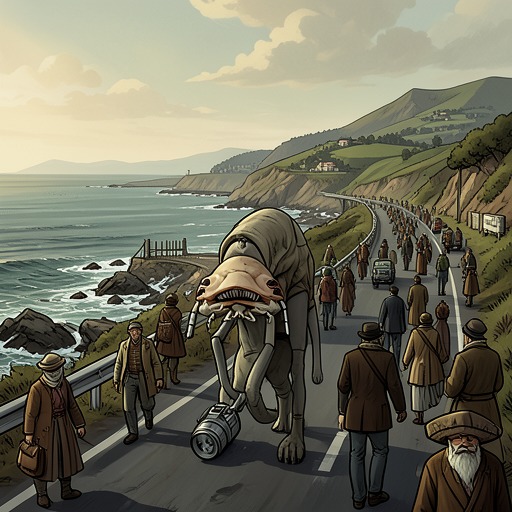
The hired motor-car
In Search of Lost TimeThe hired motor-car is both a practical convenience and an instrument that transforms the geography of the narrator’s life with Albertine. By making places once separated by arduous journeys accessible in a single afternoon, it expands their outings and alters their sense of distance; years later, the narrator discovers that the same chauffeur’s car had also linked Morel with M. de Charlus, a connection he believes might have spared him later distress over Albertine had he known of it sooner.
Arranged for Comfort and Escape
During the hot season, the narrator and Albertine went out together each day while she resumed painting, choosing the remote church of Saint-Jean-de-la-Haise as the subject of her first attempts. Reaching it was difficult: the church lay more than half an hour from Epreville station, beyond the last houses of Quetteholme, and was hard to find without guidance. The first time they traveled by a little train, then continued on foot across the countryside. The heat and the prospect of Albertine sitting still in a damp hollow after the walk worried the narrator, who arranged for a carriage from a Balbec livery stable to collect them each day.
The carriage offered shade and shelter as they took the forest road through Chantepie. In its depths, the narrator sat clasped beside Albertine and listened to birds hidden in the trees, whose songs seemed strangely detached from the small, fluttering bodies that produced them. Yet the carriage could not take them all the way to the church. At Quetteholme the narrator left Albertine to continue on foot and arranged to return for her later. He had found it difficult to share the experience of beautiful things while speaking; he felt that he could appreciate them only alone, or by pretending to be alone. He therefore made an excuse that he would visit Madame Verdurin, the Cambremers, or his mother at Balbec while Albertine painted.
A Faster Geography
Albertine objected to the separation imposed by the day’s itinerary: Saint-Jean-de-la-Haise lay in one direction and La Raspelière in another, so choosing one seemed to imprison them there for the day. In response, the narrator secretly ordered a motor-car from Saint-Fargeau. When it arrived, Albertine, who had come to meet him without knowing about the arrangement, was delighted to discover that the vehicle was for them. The narrator brought out the toque and veil he had hidden for her, and she embraced him in gratitude. The hotel waiter Aimé followed them downstairs, proud of Albertine’s smart dress and of their rare means of transport at Balbec.
Their first journey in the motor-car also revealed how completely it could rearrange their plans. Albertine had assumed they would go to La Raspelière, but the driver explained that Saint-Jean-de-la-Haise could be reached in twenty minutes and that they could continue afterward: the journey from Quetteholme to La Raspelière took no more than thirty-five. The vehicle seemed to cover in a single bound the ground that a horse could manage over twenty paces. Places that had belonged to distinct days could now be gathered into one afternoon, with their towers, steeples, and gardens appearing around tea-time.
The narrator draws from this practical change a broader reflection: distance is not simply a fixed measure in miles or kilometres, but a relation between space and time. When the journey becomes easier, the old calculation ceases to describe the place accurately. The motor-car consequently changes not only what the travelers can do but how the landscape is perceived: villages once imagined as belonging to separate worlds become neighbors within a newly compressed view. The comparison with the former separation between Méséglise and Guermantes makes the change especially clear. What had seemed impossible to combine in one day becomes an itinerary the car can accomplish.
Discovery Through Motion
The car’s effect on perception is not limited to speed. In a later reflection on motor travel, the narrator contrasts it with the homely slowness of asking a local inhabitant for directions. The chauffeur’s uncertainty can send the vehicle back over its tracks, while the shifting perspective makes a castle seem to dance with a hill, church, and sea. As the car circles an apparently elusive town and then descends toward it in the valley, motion alternately seems to strip away the mystery associated with railway travel and to make the place feel newly discovered. The vehicle helps the traveler apprehend the earth’s proportions with greater precision, as though tracing them with a compass.
Thus the car makes distance more manageable without making the landscape merely interchangeable. Its speed brings separate destinations into reach, while the circling, searching movement of the journey can sharpen the sense of arriving at a particular place. The same machine that compresses space also gives the narrator a language for describing how travel reshapes the traveler’s attention.
The Hidden Connection
More than two years after the outings, the narrator learns that M. de Charlus was among the chauffeur’s customers. Morel had been instructed to pay him, kept part of the money, and caused the chauffeur to multiply the mileage charged; in the course of these dealings, Morel had become friendly with him while pretending not to know him in front of other people. Morel also made use of the chauffeur’s car for long journeys. The car that had enabled the narrator and Albertine to travel together therefore belonged to a wider, concealed network of journeys and transactions.
The narrator says that, had he known about Morel’s connection to the chauffeur—and understood that the Verdurins’ later confidence in the driver may have come from that source—many of his troubles in Paris the following year, including much of his distress over Albertine, might have been avoided. He had no suspicion of the connection at the time. He later reports one of M. de Charlus’s coastal meals with Morel, at a long-shaped restaurant in Saint-Mars-le-Vêtu: Charlus indirectly asked Morel to have a vase of three withered roses removed, and Morel answered with embarrassment. The meal illustrates the kind of excursion the chauffeur’s car enabled, even as the narrator makes clear that these journeys were not, in themselves, directly important to him. Their significance lies in the unsuspected link they reveal between a seemingly ordinary convenience, Morel’s private dealings, and the narrator’s later anxieties.